11 Grant Funding and the Scientific Enterprise
11.1 Introduction
This chapter reveals another layer of the hidden curriculum in scientific research—one that is rarely discussed in coursework but that shapes nearly every research career in biology: the pursuit of grant funding. Securing funding is not merely a bureaucratic necessity; it is the engine that powers scientific discovery, sustains research programs, and opens doors for trainees at every career stage. Just as Chapter 7 equipped you with the skills to manage your research projects and communicate your methods, this chapter equips you with the conceptual and practical tools to understand where scientific money comes from, how to ask for it compellingly, how it is evaluated by your peers, and where to begin your own funding journey as a trainee.
11.2 The History of Federal Funding for Scientific Innovation in the United States
11.2.1 The Origins of Organized Science Support
The relationship between the United States federal government and the scientific community is one of the most consequential partnerships in modern history. For most of the nineteenth century, the federal government played only a modest role in supporting basic research. The Marine Hospital Service maintained a small laboratory as early as 1887 to investigate infectious diseases—a one-room operation that would eventually grow into the National Institutes of Health (NIH)1. Yet it was the crucible of the Second World War, more than any other event, that fundamentally transformed how the nation understood and funded science2. The mobilization of universities, private laboratories, and government agencies to solve wartime problems—from radar to penicillin to the atomic bomb—demonstrated beyond any doubt that basic scientific research could be harnessed in service of national goals.
As the war drew to a close, political leaders and scientists alike recognized that the government-science partnership could not simply dissolve with the armistice. The most influential voice in this conversation was Vannevar Bush, who had directed the wartime Office of Scientific Research and Development. At the request of President Roosevelt, Bush produced in 1945 a landmark report titled Science—The Endless Frontier, which articulated the case that sustained federal investment in basic research at universities would pay dividends not only in national security but in economic prosperity and public health2. Bush argued that government should fund the best science at the best institutions, free from political interference, and that discoveries made at the frontier of knowledge would inevitably find practical application—even when no one could predict exactly how or when. This philosophy, sometimes called the “linear model” of innovation, became the intellectual foundation upon which both the NIH and the National Science Foundation (NSF) were built.
11.2.2 The Rise of NIH
The NIH’s origins trace back to 1887 and the modest Hygienic Laboratory of the Marine Hospital Service, which was created primarily to investigate cholera and other infectious diseases arriving at American ports1. Over the following decades, Congress gradually expanded the laboratory’s mandate and resources, formally renaming it the National Institute of Health in 1930 and later broadening it into the National Institutes of Health as multiple disease-specific institutes were added. The landmark National Cancer Act of 1937 established a National Cancer Institute and introduced the model of funding extramural research through grants to university scientists—a mechanism that would come to define the NIH’s identity. Today, NIH comprises 27 institutes and centers, each with its own scientific mission and grant portfolio, and its annual budget exceeds $47 billion, making it the world’s largest public funder of biomedical research1.
The culture of NIH funding was shaped by a basic bargain: the government would provide funds, and scientists at universities and research institutions would conduct the work, retaining intellectual freedom to follow the science wherever it led. This model distinguished NIH from purely mission-driven agencies, though the tension between pure curiosity and translational goals has never fully resolved. Throughout the Cold War, congressional enthusiasm for biomedical research intensified as disease conquest became a symbol of American technological prowess. Successive administrations doubled the NIH budget multiple times over, creating what many researchers nostalgically call the “golden era” of American science funding that stretched through the late 1990s and culminated in the NIH budget doubling from 1998 to 20031.
11.2.3 The Founding and Evolution of the NSF
The National Science Foundation took a longer and more contentious path to existence. The debates that delayed its founding from 1945 to 1950 were, at their core, debates about democratic accountability versus scientific autonomy. Bush and his allies wanted an agency governed by scientists, insulated from politics, and dedicated to funding only the most excellent basic research without regard for geographic distribution2. Senator Harley Kilgore of West Virginia pushed back, arguing that federal money should be distributed more broadly—geographically and disciplinarily—and that the agency should be accountable to elected officials, not to an unelected scientific elite. When President Truman vetoed the first version of the legislation in 1947 on the grounds that it was insufficiently democratic, it took three more years of negotiation to find workable compromises2. NSF was ultimately signed into law by Truman on May 10, 1950, with a National Science Board of 24 part-time members providing oversight and a presidentially appointed director as chief executive officer3. Critically, graduate research fellowships were written into NSF’s mission from the very start: the Graduate Research Fellowship Program launched in 1952 and remains the agency’s longest continuously operating program, reflecting how central trainee support has been to the agency’s identity since its inception3,4.
In its early years, NSF was a modestly funded agency with an initial appropriation of just $225,000, dwarfed by the research programs of NIH and the Department of Defense. The shock of Sputnik in October 1957 changed everything: when the Soviet Union placed the first artificial satellite in orbit, Congress more than doubled the NSF budget almost overnight—from $40 million to $134 million in a single year—and passed the National Defense Education Act of 1958, which poured federal money into science and mathematics education at every level3. The decades that followed saw NSF’s portfolio expand well beyond the physical sciences. A 1968 amendment to the authorization act made explicit the agency’s mandate to support the social sciences and applied research and to foster development of computer technologies3. By 1985, NSF had established NSFNET—the high-speed network linking its national supercomputing centers—which became the direct technical forerunner of the internet, one of the most consequential infrastructure investments in the agency’s history3. New directorates were established as scientific fields matured: Engineering in 1981, Computer and Information Science and Engineering in 1985–86, and Social, Behavioral and Economic Sciences in 1991. In 2001, NSF coined the now-ubiquitous acronym STEM, and in 2022 it established its first new directorate in thirty years—the Directorate for Technology, Innovation and Partnerships (TIP)—specifically designed to bridge curiosity-driven basic research and use-inspired applied innovation, grow industry, and cultivate a more equitable STEM workforce3.
NSF-funded science has produced a remarkable record of foundational discoveries, many of which are woven into the fabric of everyday life: the bacterium isolated in Yellowstone hot springs that yielded the DNA polymerase behind PCR; the NSFNET backbone that gave rise to the internet; CRISPR technology characterized in 2012; the LIGO gravitational-wave observatory that confirmed Einstein’s general theory of relativity in 2016; and the Event Horizon Telescope image of the first black hole, unveiled in 20193. These outcomes were not predictable at the time of the original investments—which is precisely Bush’s point in Science—The Endless Frontier and the empirical foundation for the return-on-investment argument for basic science funding4,5. Today NSF remains distinct from NIH in that it funds a broader range of disciplines—including the mathematical and physical sciences, engineering, computer science, the social sciences, and biology—and places particular emphasis on basic research with no predetermined practical goal, while increasingly also investing in translation of discoveries toward societal benefit through programs like TIP and I-Corps3.
11.2.4 Beyond NIH and NSF: The Broader Funding Ecosystem
While NIH and NSF dominate the federal funding landscape for biology and biomedical science, they are far from the only game in town. A researcher working in computational biology or bioinformatics may find equally relevant funding from the Department of Energy (DOE), which has long supported genomics research through its Joint Genome Institute and the work surrounding the Human Genome Project. The Department of Defense funds biological research through its Defense Advanced Research Projects Agency (DARPA) and service-specific research programs, particularly in areas touching on infectious disease, biotechnology, and biosecurity. The United States Department of Agriculture (USDA), through its National Institute of Food and Agriculture (NIFA), is the primary federal funder of agricultural and food science research, and for faculty and students at land-grant universities like Auburn it represents one of the most relevant and accessible funding streams available.
Beyond federal agencies, private foundations have played an enormous role in shaping American science. The Howard Hughes Medical Institute (HHMI) supports some of the most eminent biomedical scientists in the country through long-term investigator awards explicitly designed to give researchers the freedom to take risks without the pressure of annual grant renewals. The Simons Foundation invests heavily in mathematics, computational science, and autism research. The Bill and Melinda Gates Foundation has redirected global health research priorities through strategic grantmaking at a scale that rivals government funding for certain disease areas. Professional scientific societies—from the American Society for Microbiology to the Genetics Society of America—also provide smaller grants and travel awards that, while modest in dollar terms, can be transformative for early-career researchers and trainees who are just establishing their independent scientific identities6.
The story of federal science funding in the United States cannot be told without acknowledging the remarkable experiment in public higher education that preceded the NIH and NSF by nearly a century. The Morrill Act of 1862, signed into law by President Abraham Lincoln on July 2, 1862—in the middle of the Civil War—granted each state 30,000 acres of federal land per member of Congress to establish colleges focused on agriculture, mechanic arts, and the practical sciences. The goal was explicitly democratic: to open higher education to farmers and working people who had historically been excluded from the narrow classical curriculum of existing colleges. Auburn University was designated Alabama’s land-grant institution in 1872 and has operated under that tripartite mission of teaching, research, and public service ever since.
The original 1862 Act, however, did not extend its democratic promise equally. With slavery still in force when the law passed and segregation entrenched in its aftermath, Black students were effectively excluded from most of the institutions it created. The Second Morrill Act of 1890, signed by President Benjamin Harrison on August 30, 1890, was a direct response to this injustice. It provided direct federal financial support to land-grant colleges and explicitly prohibited racial discrimination in the distribution of those funds—requiring states that maintained segregated systems to either admit Black students to existing institutions or establish separate land-grant colleges for them. This provision gave rise to the 19 institutions now known as the 1890 Land-Grant University System, all of which are Historically Black Colleges and Universities (HBCUs). Alabama is home to two of these 1890 institutions, giving it a distinctive place in land-grant history. Alabama A&M University (AAMU) was founded in 1875 by Dr. William Hooper Councill in Huntsville as the Huntsville Normal School, and by 1891 was receiving federal Morrill Act funds to support instruction in agriculture, engineering, and architecture. Tuskegee University, founded by Booker T. Washington in 1881, holds a unique status as the only private institution designated as a land-grant university under the 1890 framework. Together, Auburn, AAMU, and Tuskegee constitute Alabama’s three land-grant institutions—a trio that traces the full arc of the land-grant story, from its founding democratic ideals to the legislative corrections that Congress later found necessary to extend those ideals more broadly.
The agricultural research mission of land-grant universities was formalized and funded by the Hatch Act of 1887, which established a national system of Agricultural Experiment Stations at each land-grant institution and provided direct federal appropriations to support their work. These Hatch Act funds—administered today through USDA-NIFA—are formula-based grants distributed annually to experiment stations, supporting research programs in crop science, animal science, natural resources, and increasingly, genomics and computational biology as these tools have become essential to modern agricultural research. The Smith-Lever Act of 1914 extended the land-grant mission further by creating the Cooperative Extension Service, which translates university research into practical guidance for farmers, communities, and families across each state. NIFA also administers dedicated programs for 1890 institutions to support capacity building in research and extension, though chronic underfunding of these programs relative to their 1862 counterparts has remained a documented and ongoing equity concern.
Today, NIFA administers a portfolio of competitive and capacity-based grants that extend well beyond agriculture in the traditional sense. Competitive programs such as the Agriculture and Food Research Initiative (AFRI) fund fundamental and applied research in plant and animal genomics, food safety, climate adaptation, and bioinformatics. For students and faculty at Auburn working on topics at the intersection of biology, genetics, and agricultural systems, NIFA represents a historically grounded and institutionally supported pathway to federal research funding that is worth understanding alongside NIH and NSF.
The diversity of funding sources reflects the diversity of scientific questions and the different priorities that animate different sponsors. Understanding this landscape—knowing which agencies fund which kinds of science, and what each funder’s current programmatic priorities are—is itself a professional skill that experienced scientists cultivate over the course of their careers. No two grant applications are identical because no two funders are identical, and the successful proposal writer is always writing for a specific audience with a specific mission in mind7.
Underlying all of these mechanisms is a simple but powerful empirical case: federal investment in scientific research generates substantial returns for the national economy and public welfare. Economists estimate that every dollar invested in basic science by the federal government produces roughly $2.56 in economic growth over a ten-year horizon, a return that may be severalfold larger over multi-decadal time scales—and one that individual investors or companies would rarely make on their own because the benefits accrue broadly and unpredictably across society rather than returning to a single funder4,5,8. This is precisely the economic logic that animated Vannevar Bush’s argument in Science—The Endless Frontier and that continues to be supported by empirical research: curiosity-driven public investment creates knowledge that no market would reliably produce, because the value of a discovery often cannot be anticipated or captured by whoever paid for it9,10. Understanding this return-on-investment argument is not merely academic background; it is the core rationale that scientists are increasingly called upon to articulate when making the case for their work to funding agencies, university administrators, legislators, and the public11.
11.3 The Anatomy of a Grant Proposal
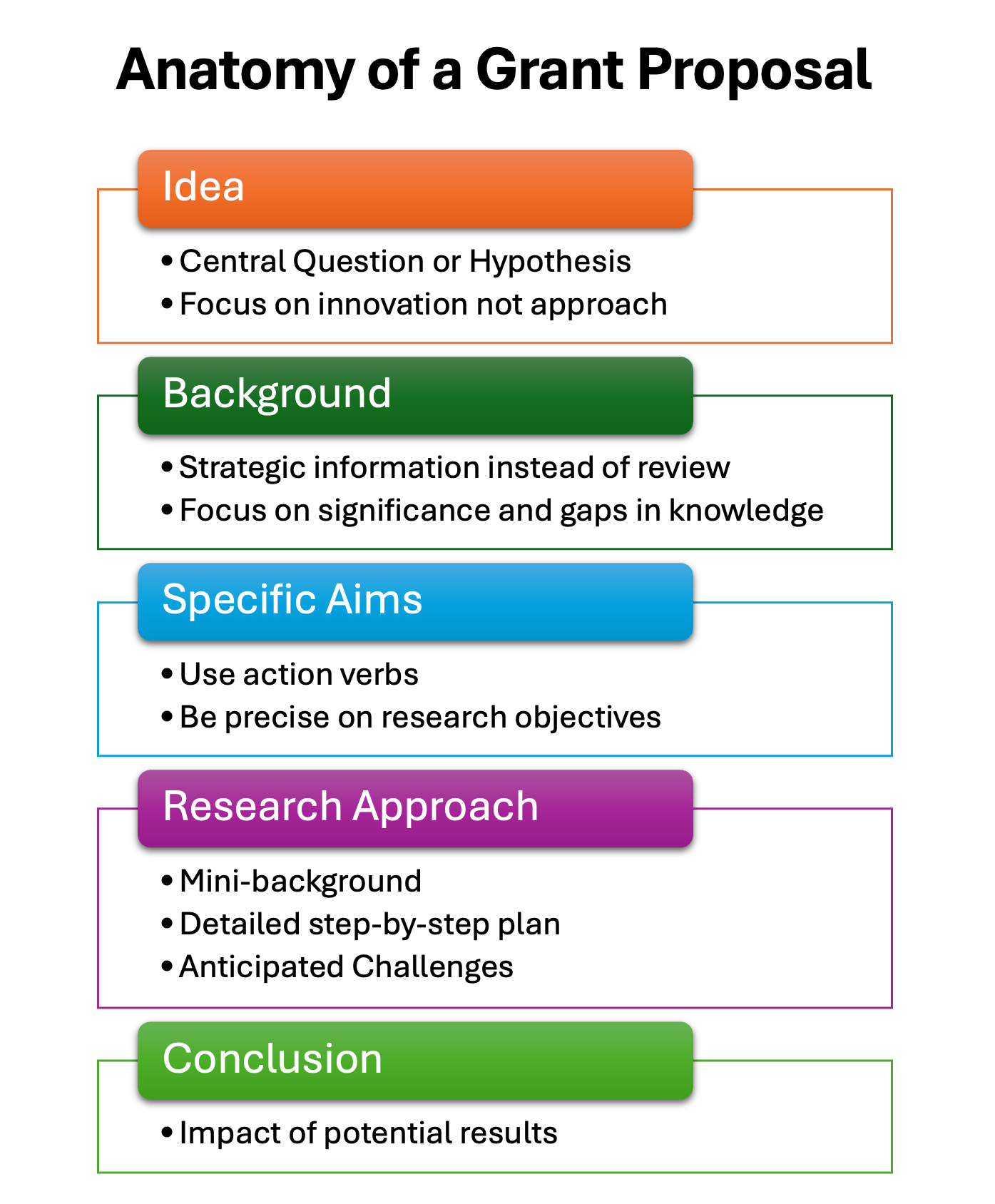
A successful grant proposal moves through five tightly linked components, each building on the last. It begins not with methods but with an idea—a central scientific question or hypothesis that frames everything that follows. The background section is not a literature review but a curated argument that establishes significance and identifies the gap your work will fill. Specific aims translate that argument into discrete, achievable goals stated with strong action verbs. The research approach provides the step-by-step experimental plan for each aim, complete with a mini-background, anticipated challenges, and alternative strategies. Finally, the conclusion closes the argument by articulating the impact of the potential results—explaining what the field, and the world, will gain if the work succeeds.
11.3.1 Beginning with an Idea
Every successful grant proposal begins long before a single word is written. It begins with a scientific idea—a question or gap in knowledge that you find genuinely compelling and that you believe is both important and tractable12. The process of converting that idea into a fundable proposal is a kind of translation: you must move from the personal, often inarticulate conviction that something is worth investigating to a clear, persuasive public argument that a community of scientific peers should agree it is worth funding. This is not a dishonest process, but it is a rhetorical one. Grant writing is a genre of scientific communication with its own conventions, its own vocabulary, and its own logic, and mastery of that genre requires practice and attention just as learning to write clear methods sections (as discussed in Chapter 7) requires practice and attention6.
The most common mistake beginning grant writers make is starting with the methods rather than the idea. A proposal built around techniques—“I will use RNA-seq and CRISPR to study gene X”—reads as a solution looking for a problem. Reviewers respond far more enthusiastically to proposals built around a scientific question—“We do not understand how organism Y responds to environmental stress Z, and answering this question has significant implications for W”—in which the methods are clearly in service of the question rather than the other way around. Before you write anything, you should be able to articulate your central idea in plain language to a scientifically literate non-specialist, because that is roughly the perspective of the reviewers who will read your proposal7.
11.3.2 Building the Necessary Background
Once your central idea is clear, the next task is constructing the background section of your proposal. This section exists for a specific purpose: to give reviewers the intellectual context they need in order to understand why your question is significant and why it has not already been answered. A common misconception is that the background section is a comprehensive literature review. It is not. It is a curated argument. You are selecting the most important prior findings, synthesizing them in a way that points toward the gap you intend to fill, and establishing that you have command of the relevant literature13. Every piece of background information included should earn its place by doing one of three things: establishing the importance of the problem, demonstrating what is already known, or revealing what remains unknown.
The final paragraph of a background section should pivot decisively from the known to the unknown. The reader should feel the intellectual tension—here is what we know, here is what we do not know, and here is why that gap matters. This pivot sets up the specific aims that follow and gives reviewers a reason to keep reading with enthusiasm rather than obligation. A well-crafted background does not just describe the field; it tells a story with an unresolved ending that your proposed research will complete14.
11.3.3 Specific Aims and the Power of Action Verbs
The specific aims section—sometimes called objectives, or research goals—is arguably the most important page in any grant proposal. It distills your entire scientific vision into a small number of discrete, achievable goals that collectively address your central question15. Many experienced grant writers treat the specific aims as the backbone of the entire proposal and draft it first, before writing any other section, because it forces clarity of thought about what the project will actually accomplish.
Each aim must be stated using a strong action verb that describes what you will do and what outcome is expected: determine, test, establish, quantify, evaluate. Passive or vague formulations—“aim one will examine aspects of the relationship between X and Y”—communicate uncertainty and imprecision, while active formulations—“Aim 1 will determine how transcription factor X modulates the expression of stress-response genes in response to heat shock in Drosophila”—communicate confidence and specificity6. A proposal that promises to “examine” a phenomenon can never truly fail, because any result counts as examination. A proposal that promises to “test the hypothesis that X causes Y” succeeds or fails based on whether that hypothesis is rigorously tested—which is exactly the kind of intellectual accountability that reviewers want to see. This is not to say that exploration driven work is not prioritized. As stated early in Chapter 1, discovery-based research is still a valid research goal. But again, the verbs you use to describe these goals matters, so an aim promising to characterize something can be perceived as descriptive, which can come across as weak. Instead, for discovery based work, use verbs such as identify, develop, etc to strengthen your specific aims descriptions. The choice of verb matters because it implicitly defines what success looks like. In a lot of ways, these verbs can be similar to verbs used in writing learning objectives for students based on what is referred to as Bloom’s Taxonomy. Simply put, the verbs match the expected level of understanding and these same principles can be useful in constructing strong specific aims statements.
It is also important that the aims be logically related without being fatally dependent on one another. If Aim 2 can only be pursued if Aim 1 succeeds, then a reviewer will worry that the entire project collapses if the first aim encounters unexpected obstacles. Experienced proposal writers often structure their aims so that each one can yield meaningful scientific results independently, even while they collectively address a larger question7. This architecture demonstrates scientific maturity and reassures reviewers that the proposed work is both ambitious and realistic.
11.3.4 Structuring the Research Approach
For each aim, the research approach section must do several things in sequence. It typically begins with a brief aim-specific background that reminds the reader why this particular aim is important and what prior evidence motivates the experimental strategy. This mini-background is not redundant with the overall background section; rather, it provides the immediate justification for the specific experiments that follow by citing the most directly relevant prior work and, often, the applicant’s own preliminary data15.
After establishing context, the approach presents the detailed experimental steps in logical order. Each step should specify not just what you will do but how you will do it, what you will measure, and what criteria you will use to interpret the results. Reviewers reading an approach section should be able to mentally simulate the experiments: they should understand the design, anticipate the likely range of outcomes, and evaluate whether the proposed methods are appropriate for the stated goals7. A common weakness in proposals from early-career investigators is that the methods are described in conceptual terms without enough procedural detail to give reviewers confidence that the investigator knows how to actually execute the work.
Every well-constructed aim should include an honest discussion of anticipated challenges and potential solutions12. This is not an invitation to undermine your own proposal by cataloguing everything that could go wrong; rather, it is a demonstration that you have thought deeply about the problem and have contingency plans in place. A proposal that anticipates no obstacles reads as naive. A proposal that anticipates specific, scientifically grounded challenges—and responds with specific alternative approaches—reads as the work of an experienced scientist who has genuinely engaged with the complexity of the question. Reviewers are themselves working scientists who know that research rarely proceeds exactly as planned, and they are reassured when they see evidence that the applicant knows this too.
11.3.5 Concluding with Impact
A strong grant proposal does not end with the last experimental protocol. It ends with a statement of what the results will mean—for the field, for human health, for society more broadly13. This conclusion is not a formality; it is the payoff of the entire argument you have been building. You began by establishing that a question is important and unanswered. You proposed a rigorous strategy for answering it. Now you must explain what the world will look like when you have succeeded. Will your findings establish a new paradigm? Will they open new therapeutic avenues? Will they provide foundational tools or datasets that will enable the broader community to do science that is currently impossible?
The best closing statements are specific rather than generic. “These studies will advance our understanding of biology” is not a compelling statement of impact. “Identifying the molecular mechanism by which organism X repairs DNA under conditions of oxidative stress will provide the first functional model for this process in a non-model eukaryote and will directly inform the development of cancer therapies targeting DNA repair pathways in human tumor cells” tells a reader exactly what will be gained and why it matters7. Thinking carefully about your impact statement also has a useful feedback effect: if you find it difficult to articulate the significance of your results, that may be a sign that your specific aims need to be sharpened or that the framing of your project needs revision.
11.4 Modern Peer Review of Grants
11.4.1 How Grants Are Submitted and Assigned
After a proposal is written, polished, and submitted through the relevant grants management system—Grants.gov for NIH and Research.gov for NSF, for example—it enters a formal review process that is far more structured than many applicants realize. Both NSF and NIH rely on panels of expert volunteer reviewers drawn from the scientific community, but the two agencies organize that review somewhat differently in ways that reflect their distinct cultures and missions. Understanding both systems is valuable, because a researcher in biology or bioinformatics will likely encounter both over the course of a career.
At NIH, most investigator-initiated research grant applications (including the workhorse R01 mechanism) are submitted to the Center for Scientific Review (CSR), which serves as the primary intake point for the vast majority of NIH applications1. The CSR assigns each application to an appropriate standing study section—a standing panel of expert reviewers organized around a scientific topic—and also assigns it to one or more NIH institutes or centers that might fund it based on programmatic fit. At NSF, proposals are submitted directly to specific programs within a directorate, and the cognizant program officer plays a much more active role from the outset in deciding how and by whom a proposal will be reviewed. NSF programs use a combination of ad hoc mail review and face-to-face panel review depending on the program, though panel-based review has become increasingly common2. For both agencies, assigned reviewers read their applications in advance and prepare written evaluations, and the panel meeting is where those individual assessments are synthesized into a collective recommendation.
11.4.2 NIH Review Criteria: Scoring for Impact
NIH review is organized around five core criteria: Significance, Investigator, Innovation, Approach, and Environment16. Each criterion receives its own score on a one-to-nine scale, and reviewers also provide an Overall Impact score—a holistic judgment of how likely the proposed work is to exert a sustained, powerful influence on the research field. The overall impact score is not simply an average of the five criterion scores; it is a deliberate synthesis that asks reviewers to weigh the relative importance of each criterion in the context of the specific application. An early-career investigator with a slightly less impressive publication record but a highly innovative idea in an understudied area might score excellently on Significance and Innovation in a way that compensates for a somewhat weaker Investigator score, for example.
At NIH, the Significance criterion asks whether the problem addressed is important, whether current knowledge will be advanced by the proposed work, and whether the scientific premise—the existing evidence base that motivates the hypothesis—is rigorously established16. The Innovation criterion asks whether the application challenges existing paradigms or develops new methodologies, and it rewards proposals that are conceptually bold rather than incremental. The Approach criterion—often the most heavily weighted in reviewer discussions—evaluates whether the experimental design is rigorously conceived, whether the applicant has adequately accounted for potential problems, and whether the statistical framework and use of appropriate controls are sound. Rigor and reproducibility have become increasingly explicit components of NIH review, including requirements that applicants address sex as a biological variable in animal and human studies and that they demonstrate the rigor of prior research underlying their hypotheses.
11.4.3 NSF Review Criteria: Intellectual Merit and Broader Impacts
NSF review is organized around two overarching criteria that have shaped how American scientists think and write about their work for decades: Intellectual Merit and Broader Impacts2. These two criteria are deceptively simple in their formulation but require genuine depth and specificity in practice. Intellectual Merit asks whether the proposed activities have the potential to advance knowledge—within the field and potentially across fields—and whether the proposed work is creative, original, or potentially transformative. Broader Impacts asks whether the proposed activities have the potential to benefit society and contribute to desired societal outcomes, a deliberately broad criterion that encompasses education, diversity, public engagement, and the training of the next generation of scientists.
The NSF panel process differs from NIH in some important structural ways. In a typical NSF review panel, a proposal is assigned a lead reviewer and a scribe—roles roughly equivalent to NIH’s primary and secondary assigned reviewers—who present their assessments to the panel and frame the discussion. The lead reviewer opens with a summary of strengths and weaknesses and states their rating, the scribe adds complementary or qualifying observations, and then the panel discusses the proposal openly. NSF uses a rating scale of Excellent, Very Good, Good, Fair, and Poor rather than NIH’s numerical one-to-nine scale, and the outcome of the panel review is typically a written panel summary that is provided to applicants as feedback. Crucially, as with NIH, NSF panelists do not make funding decisions. The program officer considers the panel’s ratings and summaries alongside programmatic priorities, balance across subfields, and available budget before making a funding recommendation to the division director.
11.4.4 What Happens at a Study Section or Review Panel
Whether the panel follows the NIH or NSF model, the meeting itself unfolds through a characteristic sequence that is worth understanding in detail. The designated official responsible for the meeting—a Scientific Review Officer (SRO) at NIH, or a program officer at NSF—opens the session, reviews procedures, manages conflicts of interest, and ensures that all discussion is conducted in accordance with agency guidelines16. Conflicts of interest are treated with great seriousness at both agencies: reviewers who have a financial, personal, or professional relationship with an applicant that could bias their evaluation are recused from that application’s discussion. In virtual meetings, conflicted reviewers are typically moved to a waiting room for the duration of the relevant discussion and returned only after scoring is complete.
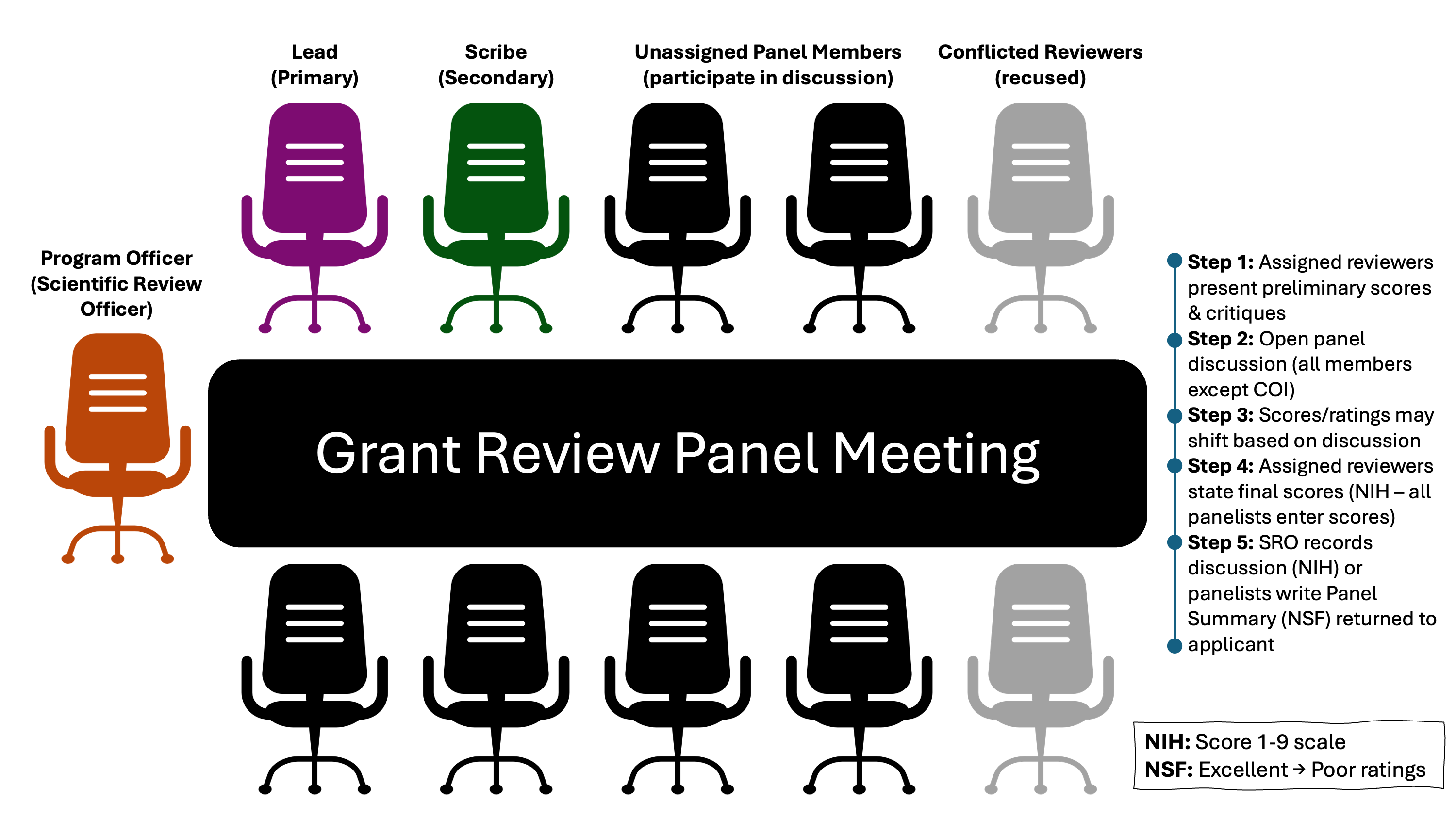
Whether modeled on NIH or NSF, all peer review panels share the same fundamental architecture. A Scientific Review Officer (SRO) or Program Officer (PO) chairs the meeting and ensures that agency regulations—including confidentiality and conflict-of-interest (COI) rules—are followed throughout. Three or more reviewers are assigned to each proposal in advance: the lead (or primary) reviewer opens discussion with a summary of strengths, weaknesses, and a preliminary score or rating; the scribe (or secondary) reviewer adds complementary observations; and together they frame the conversation for the full panel. Any panelist who is not in conflict with the application may then participate in open discussion, and scores or ratings frequently shift based on what emerges. Assigned reviewers state their final scores to define the range within which the rest of the NIH panel votes. At NIH, the SRO records the discussion whereas at NSF, the reviewers then draft a Panel Summary for the written summary that applicants ultimately receive. At NIH, overall impact is reported on a 1–9 numerical scale; at NSF, ratings follow an Excellent, Very Good, Good, Fair, or Poor scale—but the deliberative process is remarkably similar across both agencies.
Not every application receives a full discussion. At NIH, applications that receive preliminary scores in the less competitive range may be triaged before the meeting and receive only written critiques without oral discussion16. This triaging process exists because study sections often receive more applications than can be meaningfully discussed in available time; focusing the discussion on the most competitive applications uses reviewers’ time most efficiently and provides the most useful collective feedback for those applications. At NSF, all assigned proposals typically receive written reviews and a panel summary, though the depth of discussion varies with the competitiveness of the application. Receiving a “not discussed” outcome on an NIH submission can be discouraging, but the written critiques from assigned reviewers provide actionable feedback for revision.
For applications that do receive full discussion, the pattern at both agencies is similar: assigned reviewers present their assessments, discussion opens to the full panel, and scores or ratings may shift substantially based on what emerges from the conversation16. Observers of these discussions are consistently surprised by two things. First, scores can move dramatically—applications that opened with uniformly enthusiastic preliminary scores can end with mediocre final scores once unassigned panelists raise weaknesses that the assigned reviewers had not fully weighted, and vice versa. Second, the discussion is genuinely deliberative: reviewers argue, push back, and recalibrate their assessments based on the expertise and perspectives of their colleagues. This deliberative quality is not a flaw in the system; it is the system working as designed. The goal is not consensus but clarity about the strengths and weaknesses of each proposal, so that reviewers can submit final scores or ratings that accurately reflect the panel’s collective scientific judgment. At the end of a well-run panel, applicants receive both a quantitative assessment and a written narrative that together constitute some of the most targeted scientific feedback they will ever receive about their ideas.
11.4.5 The Culture of Peer Review
Sitting on a study section or NSF review panel—whether as an assigned reviewer or a general panelist—is one of the most educational experiences available to a scientist. Experienced investigators consistently report that reviewing grants improved their own grant writing because the experience makes the reviewer’s perspective viscerally real in a way that no amount of reading about review criteria can replicate. Watching how assigned reviewers present their critiques, hearing how unassigned panelists respond to a scientific argument, and observing how panel discussion shapes and sometimes overturns preliminary scores gives insights into the social dynamics of peer review that are genuinely difficult to acquire any other way16.
One important thing to understand is that peer review is not designed to produce consensus. When reviewers disagree fundamentally about whether a proposal’s central hypothesis is well-supported by prior evidence, the chair’s job is not to mediate until everyone agrees but rather to ensure that all major perspectives are clearly articulated so that the range of scores and the written critiques accurately reflect the genuine scientific disagreement. Funding rates at both NSF and NIH are sobering—competitive NSF programs may fund only five to ten percent of submitted proposals, and NIH funding rates for R01 grants at many institutes hover below twenty percent—which means that the bar for a “fundable” proposal is genuinely high, and the difference between funded and unfunded applications is often a matter of precision and depth rather than the overall quality of the science. Bias in peer review is a recognized problem that both agencies actively work to address through reviewer training, diverse panel composition, and policies designed to keep reviewers focused on the scientific content of applications.
In the associated assignment for this chapter, you will participate in a mock grant review panel that simulates the NSF panel process described above. The proposals you will be reviewing are two-page NSF Graduate Research Fellowship Program (GRFP) applications written by real graduate students—the same fellowship discussed in Section 4 of this chapter. The panel will follow the NSF framework, with a primary reviewer and a second ‘scribe’ for each proposal, open panel discussion, and a final class-wide funding vote. While this chapter presents both the NIH and NSF review frameworks because both are important for your long-term development as a scientist, the class panel favors the NSF format, using Intellectual Merit as the primary criterion and an Excellent-to-Poor rating scale rather than NIH’s numerical system. Reading the guidance in this chapter on what reviewers look for—clear questions, compelling background, rigorous approach, and honest acknowledgment of challenges—is the best preparation you can do for that assignment.
11.5 Funding Opportunities for Trainees in Biology, Bioinformatics, and the Biomedical Sciences
11.5.1 Why Trainees Should Think about Funding Early
Many students encounter the idea of applying for their own grant funding only late in their graduate careers, if at all. This is a missed opportunity. Competitive fellowship awards are among the most powerful credentials a trainee can accumulate, and not only because they come with stipends and research allowances6. A fellowship communicates to future employers, collaborators, and mentors that a trainee has already been evaluated by a community of scientific peers and found meritorious—that their ideas are not just personally interesting but publicly compelling. The process of applying, even unsuccessfully, also provides invaluable training in articulating a scientific vision, writing for a specific audience, and synthesizing a body of literature into a coherent argument. These are the same skills that will be required throughout a research career, and there is no better time to begin developing them than during training when the stakes are relatively low and mentorship is readily available.
There is also growing evidence that early career funding has lasting consequences for scientific trajectories. Research on what is sometimes called the Matthew effect in science funding suggests that early-career setbacks in funding can have disproportionate and compounding negative effects on long-term research productivity, whereas early success creates momentum that tends to persist17,18. When a program officer, foundation, or fellowship panel invests in a junior scientist, they have a demonstrated interest in seeing that investment through—meaning that initial funding often opens doors to mentorship networks, collaborative opportunities, and subsequent funding that would not otherwise have been accessible19. NSF survey data confirm that graduate students and postdoctoral researchers who hold fellowships report higher rates of research productivity, broader professional networks, and stronger career outcomes than their unfunded peers20. The practical implication is straightforward: the time to begin building your funding portfolio is not after you have something impressive to show, but during the process of developing it.
11.5.2 Opportunities for Undergraduate Researchers
Undergraduate students at research-active universities often have access to funding mechanisms specifically designed for them, though these opportunities require some navigation. At Auburn University, the Department of Biology administers an Excellence Fund that provides financial support to undergraduate students engaged in research with a faculty mentor; students must be nominated and sponsored by their research supervisor, making the mentoring relationship itself the entry point into this funding stream. More broadly available is the Office of Undergraduate Research’s Undergraduate Research Fellowship (URF) Program, which supports students who wish to pursue a self-designed research project under faculty mentorship. Applications typically require a brief project description, a faculty endorsement, and a budget, giving undergraduates their first experience with the basic architecture of a grant proposal in a low-stakes, supportive context.
Beyond the institutional level, the NSF Graduate Research Fellowship Program (GRFP)—which will be discussed in more detail below—is open to undergraduate seniors who are about to begin graduate school, making it one of the few prestigious national competitions that can be entered before a student has formally begun their graduate training2. Undergraduates who are thinking about research careers should investigate the GRFP early enough to allow adequate preparation time, because the strongest applications typically require many drafts, significant input from mentors, and the kind of intellectual clarity that develops over semesters of hands-on research experience.
11.5.3 NSF Graduate Research Fellowship Program
The NSF Graduate Research Fellowship Program (GRFP) is the most prestigious national fellowship competition for graduate students in science, technology, engineering, and mathematics, and it is the one that biology, bioinformatics, and computational biology students are most likely to encounter early in their graduate careers2. The fellowship provides three years of support, including an annual stipend and an education allowance intended to offset tuition and fees. It is open to U.S. citizens, nationals, and permanent residents who are in their first or second year of graduate school (or who are applying as undergraduate seniors or post-baccalaureate students), and importantly, each applicant may only submit one application in their lifetime—making timing and preparation especially critical.
GRFP applications are evaluated using the same two criteria that govern all NSF review: Intellectual Merit (the potential of the proposed activities to advance knowledge) and Broader Impacts (the potential to benefit society and contribute to desired societal outcomes)2. A strong GRFP application requires three components to work together: a personal statement that narrates the applicant’s scientific development and identity, a previous research experience essay that demonstrates concrete accomplishments and scientific thinking, and a research proposal that shows the applicant can formulate an independent scientific question and design a credible approach to answering it6. The research proposal is often the most challenging component for students to write well, because it requires exercising exactly the skills discussed in Section 2 of this chapter—identifying a genuine gap, building a compelling background, and articulating specific, achievable aims with the kinds of strong action verbs and realistic contingency planning that distinguish mature scientific thinking from enthusiasm alone.
11.5.4 NIH Individual Fellowship Awards
For graduate students and postdoctoral researchers in the biomedical sciences, the NIH offers a family of individual fellowship mechanisms known collectively as the F series. The F31 award, the Ruth L. Kirschstein National Research Service Award for Individual Predoctoral Fellows, supports doctoral candidates pursuing dissertations in health-related research6. There is also an F31 Diversity supplement specifically designed to enhance representation of individuals from groups underrepresented in biomedical research, including racial and ethnic minorities and individuals with disabilities. The F32 award supports postdoctoral researchers, providing a structured opportunity to develop independent research skills under the mentorship of a sponsor during the critical transition period between doctoral training and independent faculty positions.
Unlike the GRFP, which is evaluated primarily on the strength of the applicant’s ideas and potential, NIH fellowship applications involve a more elaborate review process that takes into account the proposed research project, the applicant’s background and qualifications, the mentor’s qualifications and track record, the training plan, and the environment in which the training will occur16. This means that the quality of the mentorship relationship—and the mentor’s willingness to invest time in co-developing the fellowship application—matters enormously. Students planning to apply for an F31 should initiate conversations with their mentor about the application well in advance of any deadline, ideally at least a year before the intended submission, because developing a strong individual development plan and a coherent research proposal requires sustained collaboration between the trainee and their sponsor.
11.5.5 Professional Society Grants and Other Opportunities
Beyond the major federal fellowships, a rich ecosystem of professional society grants and foundation-sponsored awards provides additional funding opportunities for graduate students and early-career researchers. Sigma Xi, the scientific research honor society, offers Grants in Aid of Research (GIAR) that provide modest awards—typically up to one thousand dollars—for travel to field sites or the purchase of equipment necessary to complete a specific research project6. These awards are small enough that they fall within reach of students early in their training, but competitive enough that earning one represents a genuine credential. The Society for Study of Evolution, the Genetics Society of America, the Society for Integrative and Comparative Biology, and many other discipline-specific societies offer analogous small grants, travel awards, and presentation fellowships.
The Phycological Society of America, for example, offers grants in aid of research for graduate students and postdoctoral researchers conducting work in phycology, while the American Association of University Women provides dissertation fellowships and international fellowships supporting women in science at the doctoral level. National databases maintained by organizations such as Pathways to Science and UCLA’s graduate funding portal maintain searchable listings of opportunities for MS and PhD students across disciplines, including travel grants, writing grants, and research awards that many students never discover simply because they do not know to look for them. The lesson here is that the funding landscape is both broader and more diverse than most students realize, and even awards that seem peripheral to your primary research area can contribute to your professional development and your CV in meaningful ways.
Making a habit of monitoring funding opportunities throughout your graduate training—building a personal calendar of relevant deadlines, discussing opportunities with your mentor and with advanced graduate students in your program, and setting aside time each semester to evaluate which competitions are most aligned with your current stage of training and scientific focus—is itself a form of professional practice that will pay dividends throughout your career. The scientists who build the most robust and sustained research programs are almost universally those who learned early to think strategically about funding, to write clearly and compellingly about their ideas, and to treat the peer review process not as an adversarial obstacle but as a community conversation about what science is most worth doing.
11.6 Conclusion
Grant funding is, at its core, a conversation between scientists about what questions matter and who is best positioned to answer them. Understanding the history of that conversation—from the Morrill Act’s vision of practical education for working people to Vannevar Bush’s vision of science as an endless frontier to the global network of federal agencies, private foundations, and professional societies that funds research today—helps you see yourself not as a supplicant asking for money but as a participant in a long and consequential tradition of publicly supported inquiry. The skills developed by writing grant proposals, by serving as a reviewer, and by navigating the peer review system are among the most durable and transferable skills in science, and there is no better time to begin developing them than during your training. The hidden curriculum revealed in this chapter is simply this: the scientists who thrive are those who learn to communicate the significance of their work not just to themselves but to the entire community that depends on good science being done well.
11.7 Practice Problem Sets
Proposal Identification Exercise: Return to the21 paper we have read throughout the semester and, using the NSF Award database, identify one of the funded grants that supported the work described. Examine the project abstract available through NSF. What elements of the proposal structure described in Figure 11.1 can you identify in the abstract alone? What is missing from the abstract that would be present in the full proposal? What other publications have been produced as a result of this research?
Specific Aims Practice: Return to your narrative submitted for Lab 2. Visit the link of action verbs and try to write specific aims for your hypothetical research project. Expand your narrative to a specific aims page, which is a 1-page mini proposal. Your aims page should include a brief statement of the central problem and gap in knowledge, two to three specific aims each written with a strong action verb, and a closing statement of expected impact. Exchange your draft with a classmate and provide written feedback specifically addressing whether the aims are logically independent, whether the action verbs are sufficiently specific, and whether the impact statement is convincing.
Reviewer Perspective Exercise: Obtain two or three funded grant abstracts from NIH Reporter in your area of interest and evaluate each one against NIH’s five core review criteria (Significance, Investigator, Innovation, Approach, Environment). Write a brief mock critique for each, identifying one major strength and one potential weakness for each criterion. Then compare your critiques with a classmate: where do you agree, and where do you disagree? What does the disagreement tell you about the subjective elements of peer review?
Study Section Role Play: In preparation for the class mock study section, read the assigned proposal carefully and prepare both a written critique and a two-minute oral summary of the major score-driving issues. Your oral summary should state your preliminary score or rating, describe the most important strengths, identify the most important weaknesses, and explain how you weighted those factors in arriving at your assessment. After the panel discussion, reflect in writing on whether your rating changed, why or why not, and what aspect of the discussion most influenced your thinking.
Funding Landscape Map: Using the resources described in Section 11.5 plus the Pathways to Science database, compile a personal funding calendar listing at least five fellowship or grant opportunities relevant to your stage of training and research area. For each opportunity, record the award name, sponsoring organization, eligibility requirements, award amount, and typical deadline. Present your calendar to a small group and discuss which opportunity you would prioritize and why.
11.8 Reflection Questions
Vannevar Bush argued in 1945 that government should fund the “best science” without regard for geographic distribution, while Senator Kilgore argued for broad-based, democratically accountable support. Both positions have continued to shape funding policy for more than 75 years. Where do you see the tension between these two visions playing out in the current funding landscape, and which perspective do you find more compelling? How might your answer change depending on whether you are thinking as a scientist, a taxpayer, or a citizen of a small state?
The Morrill Act of 1862 established land-grant universities with an explicitly democratic mission: to open higher education to farmers and working people by focusing on practical agriculture, science, and engineering. How does this original mission connect to the research you are doing or hope to do? In what ways does the modern research university, funded partly through NIFA and Hatch Act capacity grants, honor or depart from the vision that Justin Morrill and Abraham Lincoln made law?
Section 11.3 describes the specific aims page as arguably the most important page in a grant proposal. Think about a piece of research you are currently involved in or are familiar with from the literature. How would you translate that work into three specific aims, each framed around a strong action verb? What does the exercise reveal about the difference between describing what scientists did and proposing what scientists will do?
Imagine a study section or review panel where an application opened with uniformly enthusiastic scores from assigned reviewers but ended with mediocre scores after unassigned reviewers pointed out multiple independent weaknesses. What would this sequence of events reveal about the potential gap between an author’s perception of their own work and a panel’s collective evaluation of it? How might you use this insight to improve your own grant proposals or scientific writing more broadly?
This chapter presents both the NIH and NSF review frameworks because scientists in biology and bioinformatics encounter both during their careers. After participating in the class mock panel using NSF criteria, reflect on the differences you notice between evaluating proposals through the lens of Intellectual Merit alone versus the five-criteria NIH framework. Which system felt more natural to you as a reviewer, and which would you find more useful as feedback on your own proposals? What does your preference reveal about your scientific values or communication strengths?